 Technical Lodge No 5666
Technical NO 5666 Blog
August 1st 2026 - by Bro Edward Thompson
2026 was an unusual year for the Province of Yorkshire North & East Ridings (YNER) in that there were two Convocations rather than the standard one. The first, on May 9th was the Investiture of the new Right Worshipful Provincial Grandmaster Mark Iveson as well as his key Provincial Officers in both Craft and Chapter. The second was on August 1st, wherein Companions and Brethren were given honours and promotions by the Right Worshipful Provincial Grandmaster (RWPGM) Mark Iveson himself.
Before I divulge, I must apologise to readers who are not Technical unit members - I am largely writing up the Convocation from a Technical unit perspective...
I picked up W Bro Ian Parkinson and the drive to York from West Hull was simple and easy - setting off at 7.30am meant traffic was light, even in Central York. We eventually parked up at York Racecourse and joined the Companions, ready for the Royal Arch Chapter Convocation. Ian was particularly excited as he was about to be given his first Provincial Promotion - Provincial Chapter Steward. The designated room used for the Convocation was bustling with activity and I sat on the front row with other Technical Companions, namely: E Comps Rob Atkinson and Jonathan Sykes and Comp Allan McKay.
The meeting was smooth and it was a pleasure to see E Comp Ian Parkinson - 'Parki' - invested as a Steward by the Most Excellent Grand Superintendent (MEGS) Mark Iveson. Deputy Grand Superintendent (DGS) Hiten Thaker, another Technical Companion, warmly embraced 'Parki' with pride as he handed him his formal Certificate. He was then led back to his place by his guide Comp Dave Green (an outgoing Active Steward in Chapter and the current 'Joshua' in Technical Chapter). Another significant joy was seeing E Comp Paul Hillary elected as Provincial Treasurer. "You can't escape it now!" the MEGS joked to E Comp Paul after his appointment was made. Paul gave a stoic nod.
The MEGS gave his Address and after many perambulations, we left to change our regalia downstairs. 'Parki' showed us the Wand he was given for his upcoming year as Steward. "Don't break it!", I thought.
We headed for the bar before lunch and then took our drinks to our table, the York Racecourse providing a scenic backdrop. The lunch was light yet enjoyable and great conversation flowed on our table. After lunch was done and the toasts were given, we posed for a picture.
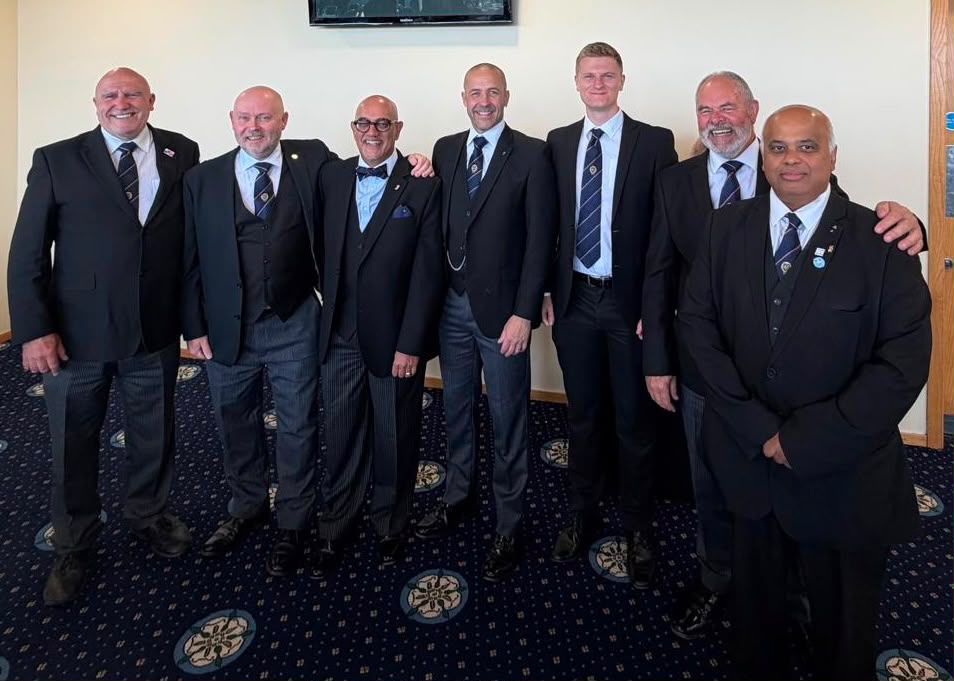
L to R: W Bro Ian Parkinson (new Chapter Steward), W Bro Paul Hillary (new Provincial Grand Treasurer), Deputy Grand Superintendent W Bro Hiten Thaker, W Bro Rob Atkinson (soon-to-be invested Craft Steward), Bro Edward Thompson, W Bro Jonathan Sykes, Bro Nandakumar Thekkootu Pisharam - please note W Bros Dave Green and Allan McKay were also in attendance but absent from the picture!
The afternoon was occupied with the Craft meeting. After another multi-staged parade of Distinguished Brethren, the meeting started and followed a similar pattern to the former Chapter meeting. Offices were given, promotions were made and notably for Technical, W Bro Robert Atkinson was invested as a Craft Provincial Steward. The Red and White apron of a Craft Steward that he now wears seemed written in the stars - it perfectly matched the colours of his beloved Hull KR as seen below:
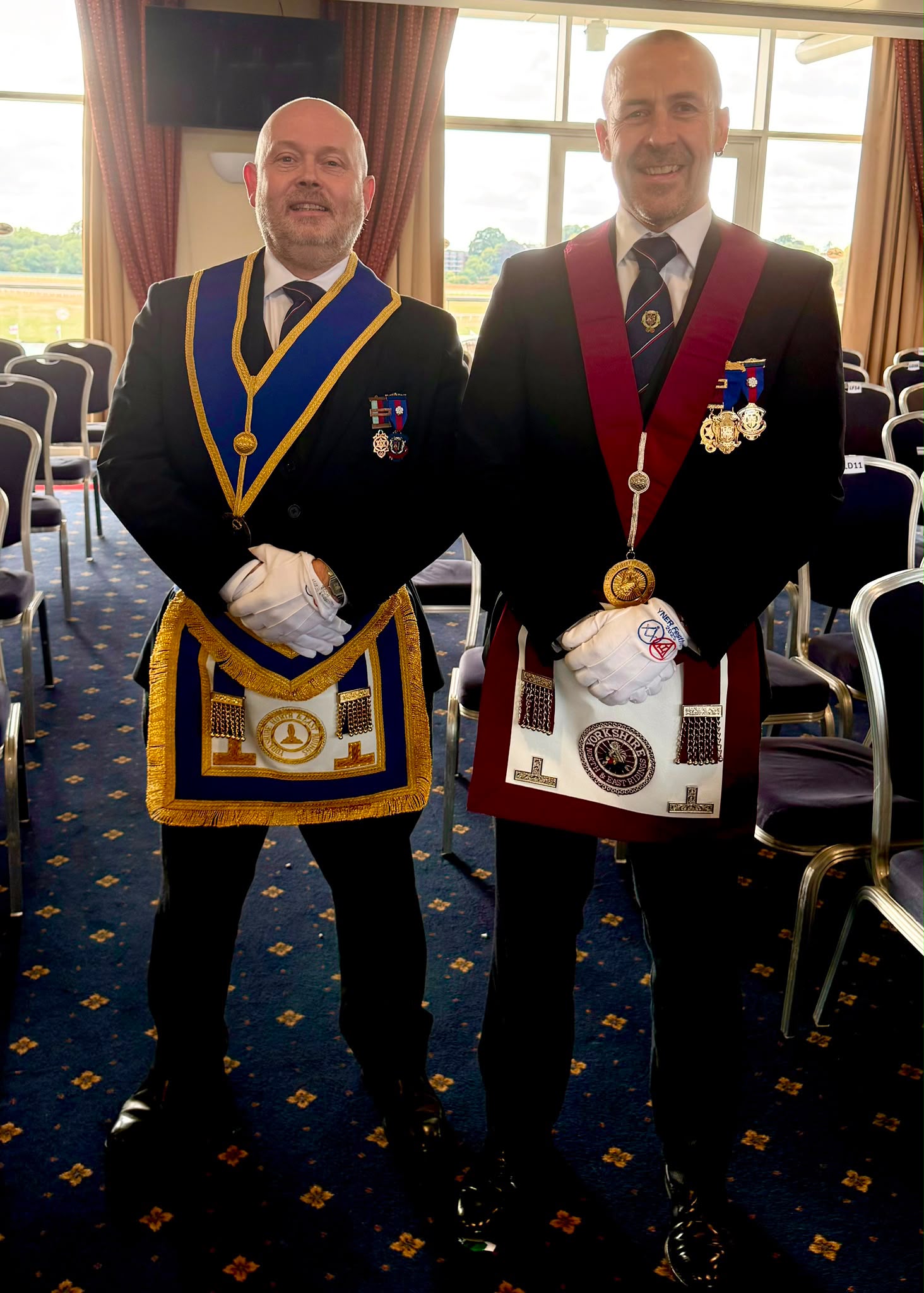
W Bro Paul Hillary and W Bro Robert Atkinson (doing his best Red Robin impression)
In summary, it was a great day of companionship, tasty food, strong esprit de corps and Brotherly Love. All members of Technical enjoyed themselves and we look forward to meeting again soon. Furthermore, the Province of Yorkshire North and East Ridings has a buzz to it - I am confident that all who attended the Convocation felt it too!
P.S. For a more comprehensive account please see W Bro Eddie Wildman's recent blog on Humber 57's Website: https://humber57.org.uk/?Blog-Page
By Anthony James, ProvGStdB
Promptly at 6.30 p.m., the Worshipful Master opened the Lodge in due and ancient form. As always, the Officers carried out their duties with confidence and professionalism, setting the scene for another enjoyable evening built around friendship, fellowship and the traditions that have shaped Freemasonry for generations.
As is often the case during the holiday season, a few Officers were unavailable, so sincere thanks go to those who stepped in at short notice to ensure the evening ran smoothly.
· W.Bro. Paul Hillary stood in as Tyler.
· Bro. Ken Wright stood in as Inner Guard.
· W.Bro. Mark Cusack stood in as Secretary.
Their willingness to help is another reminder that Freemasonry is very much a team effort. Whenever someone is needed, another Brother is always ready to step forward, and the evening ran seamlessly because of it.
The Secretary then read a portion of the Ancient Charges before presenting the minutes from our previous regular meeting on 20th June 2026, which were approved without amendment.
The usual reports followed, including my first since taking over as Lodge Mentor. Unfortunately, a particularly busy few days beforehand meant I was rather less prepared than I would have liked. My somewhat brief report proved one thing beyond any doubt; the new Lodge Mentor may still require a little mentoring himself.
The Lodge then turned its attention to three charitable proposals, each supporting a very worthwhile cause.
The first came from Bro. Bill Turner-Bone, who proposed a donation of £250 towards the Fourth Provincial Charity Cycle Ride.
This year's event will see participants tackle approximately 180 miles over three days, cycling from Whitehaven to Newcastle along the Hadrian's Wall Cycle Route. It promises to be a challenging few days, requiring determination, stamina and, I suspect, a good sense of humour once the climbs begin.
The Worshipful Master then proposed a donation of £250 to his Charity of the Year, Matthew's Hub. Later in the evening, our guests would hear more about the remarkable work the charity carries out across Hull and the East Riding.
Finally, a proposal was made to donate £250 to the homeless kitchen run by our own Bro. Adam Tunnicliffe. Adam and his team provide hot meals, practical support and, just as importantly, kindness to people facing extremely difficult circumstances.
Although each proposal supported a very different cause, together they reflected one of Freemasonry's greatest strengths, quietly supporting people and organisations that make a genuine difference within our communities. It was a fitting introduction to the presentation on Matthew's Hub that followed later in the evening.
With the business of the evening complete, the Worshipful Master moved on to the Risings before closing the Lodge in due form.
Our White Table meeting then took on a different atmosphere as wives, partners and guests joined us in the Lodge room to hear more about Matthew's Hub.
The Worshipful Master gave an informative and engaging presentation explaining how the charity came into being and the invaluable work it now carries out throughout Hull and the East Riding of Yorkshire. By the end of the presentation, everyone present had a much clearer understanding of why it had been chosen as his Charity of the Year.
Matthew's Hub is a Hull-based registered charity supporting autistic people and those with ADHD aged thirteen and over. Its services are primarily aimed at people without a learning disability, although it also offers support to individuals waiting for assessment or a formal diagnosis.
The charity itself was born from tragedy following the death by suicide of a young autistic man named Matthew. His mother, Simona, believed that with the right support, understanding and guidance, his life might have taken a very different path.
Determined that something positive should come from such a devastating loss, she worked alongside the charity FIND, together with Gill Poole, Kath Trotter and a dedicated team of autistic volunteers, to establish a specialist support service. Their commitment and hard work eventually led to Matthew's Hub becoming an independent registered charity in October 2016.
One of the things that impressed me most was learning that many of the people working within Matthew's Hub are themselves neurodivergent. That shared experience allows them to offer understanding and reassurance that can only come from having walked a similar path themselves.
The Hub provides a safe and welcoming environment where people can seek advice, build friendships and access support without fear of judgement. It also offers valuable guidance to families who are often trying to make sense of situations that can feel overwhelming.
Listening to the presentation, it soon became obvious that Matthew's Hub is about far more than providing a service. It gives people confidence, reassurance and the knowledge that they do not have to face life's challenges alone.
By the end of the presentation, I don't think anyone could fail to appreciate both the dedication of those involved and the positive difference the charity continues to make throughout our local community.
With the presentation concluded, we made our way downstairs to enjoy a relaxed White Table Festive Board in the company of our wives, partners and guests.
White Table evenings always have a different feel. They provide an opportunity for our families and friends to enjoy the social side of Freemasonry and to see first-hand the friendships that exist beyond the Lodge room.
As you would expect, the formalities were kept to a minimum. We stood proudly to sing the National Anthem, followed immediately by a loyal toast to His Majesty the King. A second toast was then given to our Grand Master, His Royal Highness the Duke of Kent. With non-Masonic guests joining us for the evening, there were no speeches, allowing everyone to relax, enjoy the meal and simply spend time together.
It was exactly as a White Table evening should be.
Conversation flowed easily around every table, with plenty of laughter throughout the room. It was particularly pleasing to see members, wives, partners and guests all mixing so naturally.
To me, that says a great deal about our Lodge.
One of the strengths of Freemasonry has always been its ability to make people feel welcome, and White Table evenings are often the perfect opportunity for our guests to experience that for themselves. While many people naturally associate Freemasonry with ceremonies and tradition, evenings like this show another side of the Craft, one built on friendship, companionship and genuine enjoyment of each other's company.
Of course, there was another topic of conversation that kept appearing around the tables.
England were due to play France later that evening.
There were plenty of opinions being shared, although very few people seemed willing to predict the final score. Whether that was caution or experience, I'm not entirely sure.
With kick-off approaching, there was certainly no appetite for a long evening. Not that anyone was rushing for the door, but equally nobody wanted to be remembered as the Brother who delayed everyone getting home in time for the match.
Fortunately, everything ran like clockwork.
The food provided by Luke and his team, as always, was excellent, the company even better, and the relaxed atmosphere rounded off a thoroughly enjoyable evening. There is something rather special about seeing everyone chatting so comfortably together.
As I looked around the room, it reminded me that while our ceremonies are an important part of Freemasonry, it is the friendships we build that keep people coming back year after year.
Looking back on the evening as a whole, it struck a wonderful balance.
We carried out the business of the Lodge, supported three worthwhile charitable causes, learned about the outstanding work being undertaken by Matthew's Hub and then enjoyed a relaxed White Table evening in the company of our families and guests.
For me, that sums up Freemasonry perfectly. We take our work seriously when we're in the Lodge, but we never lose sight of the friendships that make it all worthwhile.
As this was my first meeting as Lodge Mentor, it was also an evening I shall remember for another reason. My report may have been a little shorter than I had intended, but I now have a much clearer idea of what lies ahead.
And, of course, I also know exactly what advice I'll continue to receive from my predecessor.
"Solomon... Solomon... Solomon."
I have a feeling I'll be hearing those words for quite some time yet.
All in all, it was another memorable evening in excellent company. We left having enjoyed good fellowship, learned about an exceptional local charity and spent time with our families and friends.
Better still, we all made it home in time to watch England beat France.
I couldn't think of a better way to round off a very enjoyable evening.
By Ed Thompson
On Tuesday 7th May, Technical Chapter No.5666 had a deep and insightful meeting. Due to a few absences, the meeting required Companions to stand in. These were: E Comp Ian Parkinson as MEZ, E Comp Keith Challis as DC and Comp Tony James as Janitor. Tony, outside the door for the entire meeting, had lots of time to think and wonder - but more on that later.
Standing in as MEZ for E Comp Rob Atkinson, E Comp Ian warmly welcomed all Companions present with a smile on his face. After the Chapter opened, it was then time for the main items of business to ensue. A trident of educational and enlightening talks were to be performed.
Firstly came the Historical Lecture, delivered by Scribe E, E Comp Steve Berry. Companion Steve divulged into the three epochs in the history of Freemasonry namely The First or Holy Lodge; The Second or Sacred Lodge and the Third or Grand and Royal Lodge.
Second was the Symbolical Lecture, delivered by myself. This lecture explained the symbolism behind the Chapter Jewel, the Principal Colours of the Royal Arch (Crimson and Blue), the Staves, the Four Principal Banners, the Sceptres and the 'Working Tools' of the Royal Arch Degree.
The final talk was led by Deputy Grand Superintendent of the Province of Yorkshire North & East Ridings and Mentor of Technical Chapter No.5666, E Comp Hiten Thaker. Tying in with the previous lectures, E Comp Hiten explained the indissoluble link between Craft and Chapter. Using the Supreme Chapter Certificate as a clear reference of that link, he briefed the Companions on the history of the Royal Arch and its connection to Craft. Further to that, E Comp Hiten encouraged all to use Solomon Online Learning Platform to engage with Royal Arch Chapter on a deeper level. The incentive was twofold - not only does learning through Solomon make the Chapter experience more meaningful but you also get a formal certificate presented to you as a by-product of your hard work in completing the modules. E Comp Hiten highlighted that it was surprisingly fun and rewarding to complete all four modules - I can echo this in my own experience of Solomon.
Mentioned too was Portal which will no doubt revolutionise Freemasonry in many ways. Several Technical Companions have signed onto Portal and indeed stood up on this evening to testify its usefulness and the value it brings.
After the main business concluded, the stand-in MEZ formally congratulated E Comp Thaker on his investiture as Deputy Grand Superintendent and noted that his hard work and dedication was a great example for all in Technical to follow. He was then given a hearty applause.
E Comp Neil Armstrong, Provincial Chapter Mentor, gave greetings from Kingston Chapter No.1010 (in his capacity of Provincial Support Officer to Technical) and I gave fraternal regards from the Companions of Technical Chapter to the MEZ and his co-Principles.
The Festive Board was very jovial from start to finish and the meal was as equally cooling as it was wonderfully delicious - perfect on a very warm evening. Great conservation filled the room and we departed in gratitude of meeting together again.
I will leave the final words for Comp Tony James, who stood pondering behind the door as Janitor...
There I was, sat outside the lodge, looking deeply official standing in as the Janitor.
In front of me sat the spy hole, staring back like it knew more than I did.
In the lock was a key so large it looked like it could open York Minster.
I gave it a respectful nod, just in case it outranked me.
The spy hole remained silent, which was probably for the best as I hadn’t learned any words.
The key, however, had the confidence of something that had seen centuries of Masonic secrets.
I wondered if I should bow, salute, or simply apologise for being there.
In truth, I was just waiting for someone who knew what they were doing.
Still, I sat there proudly, master of the key, and servant of the spy hole.
By Ed Thompson
On Saturday 20th June, Technical Lodge No.5666 performed a re-enactment of a First Degree Ceremony as its main business.
Due to holidays, other engagements and some ill health, numbers were slightly lower and some stand ins were required. These empty slots were filled in quickly and conscientiously: W Bro Phillip Daniels agreed to be Tyler; W Bro Keith Challis stood in as IPM; and W Bro Steve Berry acted as Secretary. Over a hundred years of combined masonic experience ensured proceedings were very smooth and they kept us younger officers on track. W Bro Allan McKay drew a wry smile when he was asked to be 'Candidate' by Lecture Master W Bro Jonathon Sykes.
It was 6.30pm when Director of Ceremonies W Bro Rob Atkinson kicked off proceedings before handing over to the Worshipful Master Arash Vesali to formally open the Lodge. The Secretary then temporarily retired to ensure 'Mr McKay' had signed his 'necessary paperwork' and was in attendance. A report was given by Inner Guard Bro Paul Draper to the Junior Warden Bro Nandakumar Thekkootupisharam and the Secretary returned to his place after informing the Worshipful Master of 'Mr McKay's circumstances.
The tyler than knocked and Bro Draper informed Bro Nanda of an alarm. 'Mr McKay' was then admitted in due and antient form before being conducted by Junior Deacon Malcom Hussain Gambles. 'Mr McKay' then became 'Brother McKay' as he was obligated by the Worshipful Master.
Next up was the main bodies of ritual. Bro John Hemingway informed Bro McKay of the three Lesser Lights in Freemasonry. I communicated the Secrets of an Entered Apprentice Freemason after which they were exchanged with the Wardens. Senior Warden Bro Adam Tunnicliffe invested Bro McKay with his Entered Apprentice apron - which was strange seeing Allan in that piece of kit!
Bro David Turner explained the significance of the North East Corner before Bro Draper temporarily absented his Inner Guard post to claim Bro Allan's attention to the Warrant of the Lodge. W Bro Sykes explained the symbolism behind the Working Tools of an Entered Apprentice before Bro Bill Turner-Bone delivered the Antient Charge.
Bro McKay listened attentively to both Wardens when he learnt of the answers to the questions needed to advance to the next degree. He then retired and the re-enactment was complete. Due to the heat, it was quite a physically challenging ceremony but everyone persevered and completed their duties heartfully.
The only other major business that an announcement was made that our 'candidate' W Bro Allan McKay would be taking over the vacant office of Almoner - this was very well received by the Brethren in attendance.
The festive board was smaller than usual but no less enjoyable. The food was cooling and delicious, the Whiskey flowed generously and all Brethren left in great spirits at about 9.30pm, out to a light and pleasantly cooler Summer's night.
Tuesday 9th June 2026 - By Anthony James ProvGStdB
The Chapter was opened in due form at 6.30pm prompt, with the usual sense of order and ceremony. The minutes of the previous Chapter meeting were then presented and duly confirmed.
The MEZ, M.E. Rob Atkinson, then called for a ballot for Bro. John Hemingway to become a member of Technical Chapter No. 5666. The ballot proved to be in favour, and it was confirmed that Bro. John Hemingway will be exalted at our July meeting. This was very pleasing news and will no doubt be a memorable evening for both Bro. John and the Chapter.
The MEZ then invited the Provincial Prior’s Bodyguard Team to retire from the Chapter in order to prepare for their presentation, entitled Knights Templar Meets Chapter. After a short interval, the team were readmitted, this time dressed in their Knights Templar regalia.
It has to be said, they made a very impressive entrance. The regalia brought a real sense of colour, dignity and tradition to the room, and immediately gave the evening a different atmosphere. There is always something striking about seeing another Order represented in full dress, particularly when it is presented with such pride and respect.
Unfortunately, due to having to attend to a medical issue outside the Lodge, I missed much of the presentation itself. However, from what I did see, it was clear that a great deal of effort had gone into it, and the appearance of the Bodyguard Team certainly left a strong impression.
For the purposes of this blog, and to support the theme of the evening, I have prepared the following piece on the Knights Templar. I hope it gives some useful background to the Order, its history, its symbolism, and its continuing place within Masonic life today.
The year is 1099, and on 15 July, the walls of Jerusalem finally fell.
For weeks, the city had endured fear, fire, hunger and prayer. Beyond its defences stood the army of the First Crusade, exhausted, bloodied, and driven by a belief that God Himself had led them there. When the walls were breached and the gates fell, Jerusalem was no longer a distant dream whispered across Europe. It was a prize, a battlefield, and a Holy City about to be drowned in history.
Yet from the violence of that day would come something even more enduring than conquest. It would give rise to a brotherhood of warrior monks, sworn to poverty, faith and the sword. They would become known to the world as the Knights Templar.
In 1118, nine knights, led by Hugues de Payens, made the decision to dedicate their lives to the protection and service of the Holy Land. They approached King Baldwin II of Jerusalem, who granted them quarters on the Temple Mount, within part of the al-Aqsa Mosque complex. This site was traditionally believed to stand on the ground once occupied by the Temple of Solomon.
It was from this association that the knights took their name. In Latin, they were known as Pauperes commilitones Christi Templique Salomonici, meaning the Poor Fellow-Soldiers of Christ and of the Temple of Solomon. In time, they became more commonly known as the Knights of the Temple, and later simply as the Knights Templar.
Today, the full title of the Order is The United Religious, Military and Masonic Orders of the Temple and of St John of Jerusalem, Palestine, Rhodes and Malta in England and Wales and its Provinces Overseas. It is widely regarded as the longest title of any Masonic Order, and it reflects the Order’s historic connection with the Temple, the Holy Land, and the later traditions associated with St John, Rhodes and Malta.
The earliest references to Templar activity in the British Isles can be traced to Ireland. In England, the first recorded Masonic references appear at Portsmouth in 1777, where the Knights Templar degree was worked under the authority of Royal Arch Chapters as an appendant degree.
By 1791, a Grand Conclave had been formed. It consisted of seven appendant Encampments, with Thomas Dunckerley as Grand Master. Yorkshire has a particularly strong link with this history. The oldest Knight Templar unit in the county is now based in Hull, although its origins lie in York. It can show a continuous existence from 1778, and today works under a warrant granted in 1791, following the establishment of the Grand Conclave. This is the Ancient York Conclave of Redemption “B” Time Immemorial.
At that time, Freemasonry still had a clear Christian foundation and was worked in five degrees under one Lodge warrant. The first three degrees were those we now recognise as Craft Masonry. The fourth was connected with the Chapter, and the fifth with the Knights Templar.
Over the years, Craft Masonry and the Royal Arch moved away from that original Christian basis. Even so, traces of the old relationship between the degrees can still be seen in parts of the present-day Knights Templar ceremonies. These links give the Order a strong sense of continuity and help to preserve its connection with earlier Masonic practice.
Membership of the Knights Templar is more specific than membership of Craft Freemasonry. In standard Freemasonry, a candidate is required to profess a belief in a Supreme Being. For the Knights Templar, however, the requirements go further. A candidate must already be a Master Mason, must have been exalted into the Holy Royal Arch, and must profess a Trinitarian Christian faith.
In the Province of North and East Yorkshire, there are now thirteen Preceptories and several hundred members. These members are known as Sir Knights and Brother Knights.
What makes the story of the Knights Templar so enduring is the unusual nature of the original medieval Order. They were not simply knights in armour. They were men bound by religious vows, living under rule and discipline, while also taking the field as soldiers of the Crusades. Few institutions in history have combined such different worlds so completely. They were part monastery, part army, and part international brotherhood, created to protect pilgrims and serve the Holy Land.
That mixture of faith, service, sacrifice and military duty is what gave the Knights Templar their lasting fascination. It is also why their name still carries such power today, many centuries after the fall of Jerusalem and the disappearance of the original medieval Order.
The fascination of the Knights Templar lies not only in what they were, but in what they became: warrior monks, bankers, builders, symbols of Christian chivalry, victims of politics, and, centuries later, an enduring inspiration within Masonic tradition.
By the time I was able to re-enter the Chapter, the presentation had unfortunately come to an end. From the comments made afterwards, it was clear that it had been very well received by the Companions present, and that the Provincial Prior’s Bodyguard Team had delivered an interesting and worthwhile presentation.
Bro. Ken Wright was due to receive his Chapter Certificate during the evening, but sadly he was unable to attend. It is hoped that this will now be presented to him at our next meeting, when he can receive it properly and with the recognition it deserves.
The usual reports were then given, along with any other business. Greetings were received from visiting Companions, and the Chapter was closed in due form with the usual ceremony and dignity.
We then retired to the Festive Board, where the evening continued in a warm and relaxed atmosphere. As always, it was good to enjoy good food, good company and plenty of friendly conversation after the formal business of the Chapter had concluded.
Although I missed much of the presentation itself, the evening still proved to be both enjoyable and memorable. It was pleasing to see the Chapter well supported, to welcome the presence of the Provincial Prior’s Bodyguard Team, and to look ahead to Bro. John Hemingway’s exaltation at our July meeting.
All in all, it was another successful evening for Technical Chapter No. 5666, combining ceremony, companionship, Masonic interest and the fellowship that makes these meetings so worthwhile.