 Technical Lodge No 5666
Technical NO 5666 Blog
By Ed Thompson, Senior Deacon, Principal Sojourner 29th May 2026
Technical Chapter were on the road again. The drive to Northallerton took just over 90 minutes. I drove and was in good company - E Comp Eddie Wildman of Kingston Chapter No.1010 along with Technical Companion Nandakumar Thekkootu Pisharam (‘Nanda’). It was mine and Nanda’s first time in Northallerton however Eddie had previously visited Anchor Lodge No.1337 on a separate occasion, but not their Chapter. So, it promised to be an interesting experience for all of us.
We arrived in decent time and were warmly welcomed to Northallerton Masonic Hall by Companions already there, of which there were many. Anchor Chapter is well supported, and their companions commit themselves heartfully.
I did not just simply need to see their strong attendance to understand their enthusiasm as a Chapter. At Humber Chapter No.57’s installation earlier in the year, they brought 8 companions to visit. Technical Chapter brought 7.
On that evening, the Southern Travelling Sceptre was claimed by Anchor as they had the most visitors present on that occasion. There are 3 Travelling Sceptres in YNER Chapter Province, each representing the geographical areas – Southern, Central and Northern. To claim all 3, a remarkable feat that Anchor Chapter achieved, the successful Chapter with etch its name on the Provincial Wall of Fame. Falling short at Humber Chapter’s Installation by just 1 companion, Anchor kindly agreed to relinquish the Southern Sceptre to Technical, once they achieved their noble goal.
Their main business was very informative and insightful. Provided by information from Solomon –UGLE’s online learning platform – each Chapter officer explained the history and meaning behind their respective roles. Further education was also given on some of the Chapter banners. After which, they balloted for a candidate to be Exalted in their September meeting. The Sceptres were then presented and handed back to their respective geographic areas.
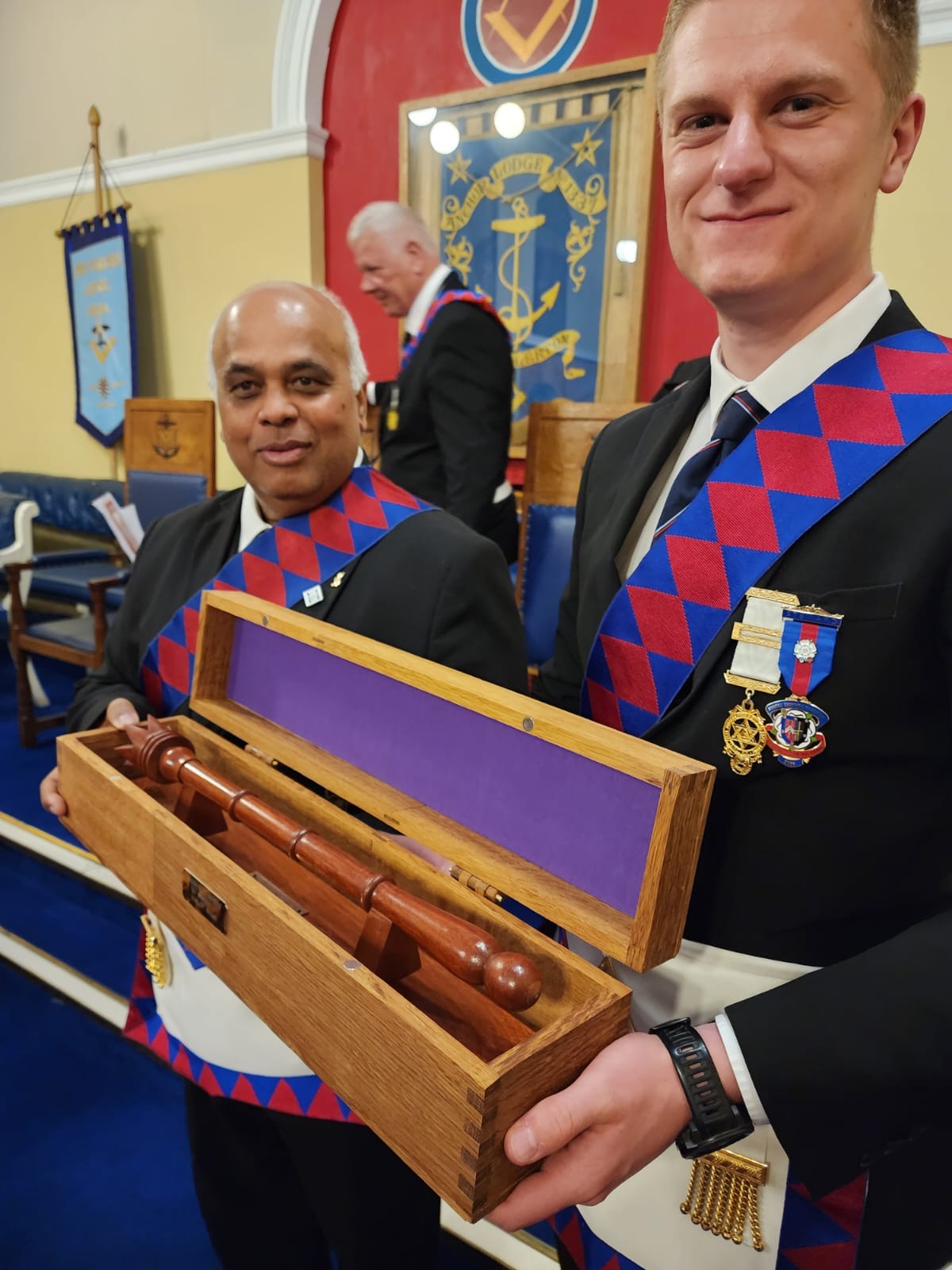
Companions Nandakumar Thekkootu Pisharam and Ed Thompson
presented with Southern Travelling Sceptre
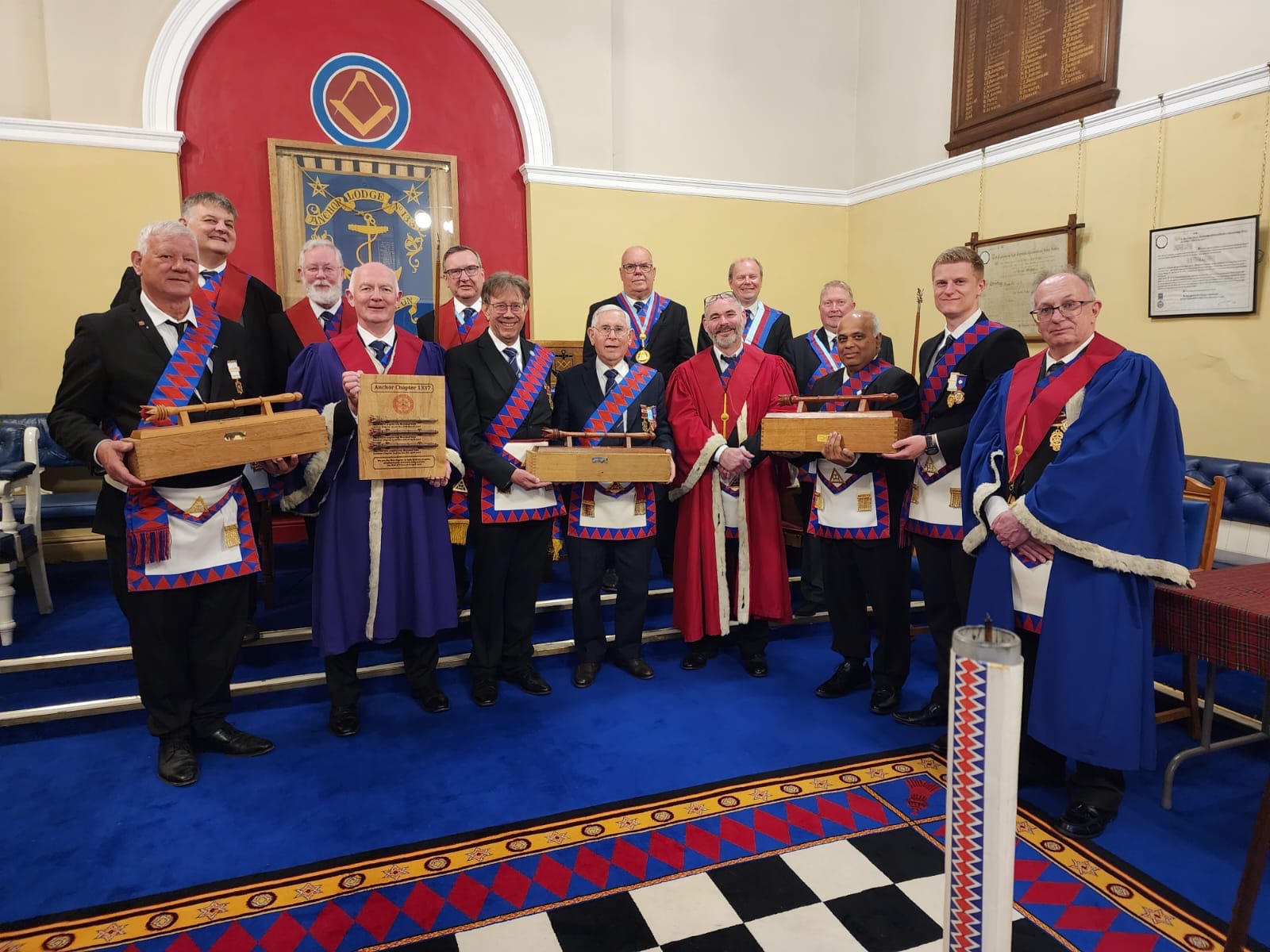
Companions of Anchor Chapter presenting the Travelling Sceptres to Companions of their respective regions.
Eddie, who was great company in my passenger seat on the long drive North, gave his regards firstly from the Supreme Grand Chapter of England and secondly from Kingston Chapter No.1010. Stood with Nanda, I gave regards from Technical Chapter No.5666.
The festive board was filled with warmth, fun and great fraternal cheer. Although football talk was frequent, as a Hull City supporter, I only made occasional digs at the Middlesbrough fans present - of which there were many.
Whilst Middlesbrough’s position in the final – placed in there retrospectively by an Independent Football Panel after their controversial semifinal defeat - was a dubious one, Eddie, Nanda and I were in the right place on that Friday evening. It was a truly fantastic night and well worth the long travel and late night.
Technical Lodge now has the Travelling Gavel in Craft as well as the Southern Travelling Sceptre in Chapter. We now look forward to welcoming visitors to our proud Masonic Unit which we all love and cherish.
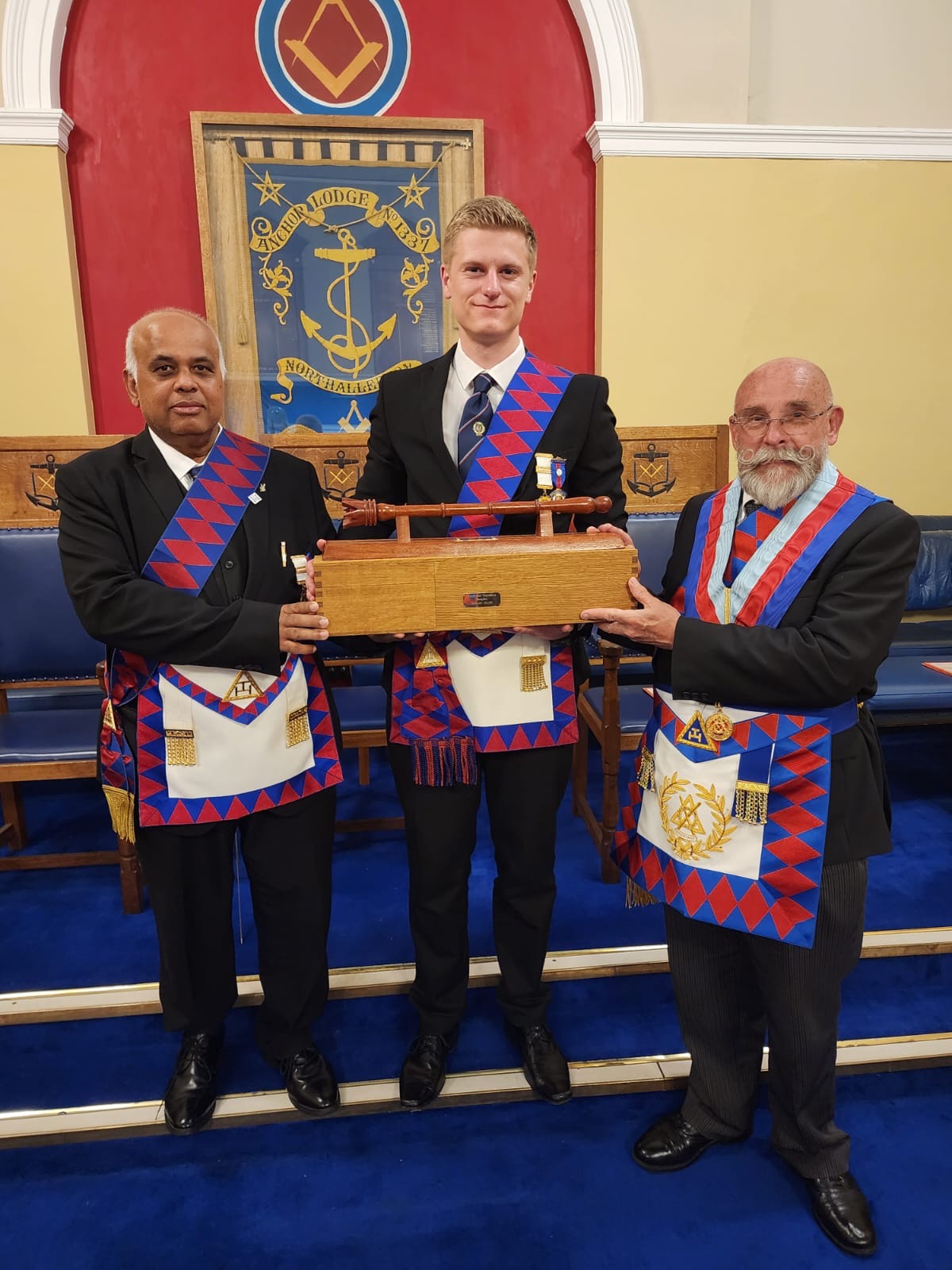
L to R: Companion Nandakumar Thekkootu Pisharam, Companion Ed Thompson, E Comp Eddie Wildman
By Anthony James, ProvGStdB - Monday 18th May 2026
It was a great pleasure to be part of the visiting Provincial team in my role as Provincial Grand Standard Bearer, accompanying the Provincial Grand Master, RW Bro Mark Iveson, PAGDC.
Also present on this very special occasion was the Past Deputy Grand Master, Sir David Wootton, whose attendance added an extra sense of warmth and distinction to an already memorable evening.
The occasion was historic in every sense of the word, marking the first time a Lodge meeting had been officially held within a hospice. Special dispensation had been granted to enable Scarborough Lodge No. 1147 to meet at St Catherine’s, making the evening both unique and deeply meaningful.
From the outset, there was a quiet dignity about the proceedings. This was far more than a Lodge meeting in an unusual setting. It was a powerful reminder of Freemasonry at its most compassionate and humane. To witness such an event as part of the Provincial team was a genuine privilege, and one that will remain in the memories of all who were fortunate enough to attend.
WBro Tony Dyer then gave a short but thoughtful talk on the Masonic Aware Project, explaining how the initiative helps to build stronger links between Freemasonry and the wider community. Rather than speaking about it in detail here, I will simply say that St Catherine’s involvement in the project is a fine example of that work in action. WBro Philip Daniels will hopefully be giving a talk on the Masonic Aware Project in the near future, so I would not wish to steal his thunder. Suffice to say, it is a fantastic initiative, and one that shows Freemasonry engaging with the community in a practical and meaningful way.
WBro Ray Baird, Chief Executive Officer of St Catherine’s, then delivered a fascinating and informative talk about the charity and the wide range of services it provides.
He posed an intriguing question to the brethren: “What possible link could there be between a modern hospice and Freemasonry?”
The answer lay in the word Hospitium, an ancient term used to describe a place of shelter and hospitality for weary travellers, pilgrims, and those returning from the Crusades.
It was a fitting comparison. Freemasonry has long been founded upon principles of charity, compassion, and care for those in need. St Catherine’s reflects those same values, offering comfort, dignity, and practical support to patients and their families during some of life’s most challenging moments.
WBro Ray Baird also spoke about an innovative project at St Catherine’s, a holiday flat built within the grounds. As well as providing visitors with a peaceful and welcoming place to stay, it generates a valuable source of income for the charity. In this way, the ancient concept of Hospitium continues to live on, providing both hospitality and practical support.
Another particularly interesting point was that St Catherine’s is gradually moving away from using the word “hospice”, as many people understandably associate it solely with death. In reality, the organisation offers far more than end-of-life care. Its aim is to support patients in living as fully and meaningfully as possible, and, where circumstances allow, to help them return home with continued care and support.
This offered a much warmer and more hopeful understanding of the work carried out at St Catherine’s. It is not simply a place where life ends, but a centre of compassion, dignity, and renewed quality of life.
Following this enlightening presentation, RW Bro Mark Iveson presented a number of Solomon Diplomas and Certificates, one of which was awarded to the Worshipful Master, WBro Greg Fox.
The Lodge was then closed in due form, and the Brethren reconvened in St Catherine’s restaurant, Flavours.
There, we were treated to an excellent three-course meal, accompanied by warm conversation and the special sense of fellowship that always comes from visiting another Lodge.
It was, in every respect, a memorable and deeply meaningful evening.
By Anthony James, ProvGStdB
It is strange how things in life sometimes seem to link together.
Earlier in the day, while working on my latest book and researching new content for the UK Author Promotion website, I came across the name François-Marie Arouet, better known to the world as Voltaire.
By coincidence, on this very date, 16th May 1717, Voltaire was imprisoned in the Bastille for refusing to stay silent in the face of ignorance and injustice. That seemed particularly fitting on an evening centred around the Second Degree, with its emphasis on learning, understanding, and the steady pursuit of knowledge.
Voltaire was never afraid to question accepted ideas, think for himself, or search for truth. Those qualities sit comfortably alongside the lessons of the Fellow Craft Degree, which reminds us that knowledge is not something we simply receive. It is something we work for, value, and use with courage.
Later in life, Voltaire became a Freemason, joining a fraternity whose values of knowledge, tolerance, and personal growth reflected much of what he had stood for throughout his life. There is a popular misconception that Benjamin Franklin initiated Voltaire. In Fact Benjamin Franklin did not “initiate” Voltaire in the sense of being the Worshipful Master conducting the ceremony. The more accurate version is that Franklin assisted at Voltaire’s Masonic initiation and acted as one of his conductors, alongside Antoine Court de Gébelin.
As Bro. Michael Carr was to be passed to the Second Degree, it felt fitting to reflect on that same search for knowledge and understanding. The Fellow Craft Degree encourages us to think more deeply, continue learning, and keep building our character. It also reminds us, through its own words, of the importance of extending our research. Voltaire’s life is a fine example of that principle in action, a man who never stopped questioning, studying, and searching for truth.
His example reminds us that the pursuit of knowledge is not always easy, but it is always worthwhile.
On arrival at the Lodge, it was lovely to see Bro. Ken Wright back with us after a period of ill-health. His presence had certainly been missed, and it was good to see him once again among friends and Brethren.
At the appointed time, the Director of Ceremonies, W.Bro. Rob Atkinson, called the Brethren to assemble upstairs and prepare for the evening’s proceedings. I took my seat as Immediate Past Master, ready for what promised to be another memorable night in the Lodge.
Unfortunately, W.Bro. Ian Parkinson, Tyler, was unable to attend this evening, but W.Bro. Frank Lovely kindly stepped in and carried out the role, ensuring everything continued smoothly.
The Lodge was opened in due and ancient form, with every Officer carrying out his duties with warmth, dignity, and feeling. Greetings were then given to W.Bro. Eddie Wildman, an Officer on the roll of the Grand Lodge of England.
As an active Provincial Officer, ProvGStdB, it was an honour to take part in the Honour Guard for W.Bro. Paul Harper, the Representative of the Right Worshipful Provincial Grand Master. It added a real sense of occasion to the evening and set the tone for what was to follow.
Once everyone was seated, the minutes of the last regular meeting were confirmed as an accurate record, and a portion of the ancient charges was read aloud.
Bro. Carr was then asked by the Worshipful Master whether it was his wish to take a higher degree in Freemasonry. Bro. Carr confirmed that it was. He was then placed in the care of the Junior Deacon, Bro. Malcolm Gambles, before the Worshipful Master proceeded to test him on the questions with which he had been asked to make himself acquainted.
Bro. Carr answered each one clearly and confidently, showing the effort he had put into his preparation and acquitting himself extremely well.
Having then been instructed in that which would form his necessary passport to gain admission to a Fellow Craft Lodge, he retired from the Lodge to prepare himself to be passed to the Second Degree. The Worshipful Master, aided by his Officers, then opened the Lodge in the Second Degree.
Why “Passed” to the Second Degree?
The phrase “passed to the Second Degree” has its roots in the language of the old operative craft. In earlier times, an apprentice who had learned enough of his trade, shown competence, and proved himself ready for greater responsibility could be passed by his master to the next stage of training.
Freemasonry preserved this wording, giving it a deeper moral and symbolic meaning within the ceremony.
In the UK, the Second Degree focuses strongly on education, knowledge, personal development, and the lessons connected with the working tools of a Fellow Craft. It marks a clear step forward from the First Degree, moving the candidate from the foundations of initiation into a broader understanding of Masonic learning.
To be “passed” therefore symbolises that the candidate has demonstrated sufficient understanding of the First Degree, shown readiness to advance, and been approved by the Lodge to continue his Masonic journey.
It is not simply a promotion or a change of title. It is a recognition of progress, both in knowledge and character, and reminds us that the early stages of our Masonic journey are part of a much wider path towards deeper understanding and, in time, mastery.
Tonight, outside the door of the Lodge, our candidate, Bro. Michael Carr, waited with that familiar mixture of nerves, curiosity, and excitement that every Mason will recognise. The Second Degree marks a significant step on a man’s journey in Freemasonry, bringing with it both honour and challenge.
S.W. Bro. Ed Thompson, acting as Senior Deacon, guided Bro. Carr through the ceremony in a calm and steady manner, helping him through each stage with quiet confidence and reassurance.
The Worshipful Master carried out the obligation with confidence, apart from one slight slip of the tongue, when reference was made to the “Grand Magician of the Universe”. A little laughter could be heard around the room as the Brethren realised what had been said. It was one of those harmless human moments that brings a smile to an evening, without taking anything away from the ceremony itself.
The communication was delivered by Bro. David Turner, who carried out his part with confidence and clarity.
Bro. Tunnicliffe, Senior Warden, then had the honour of investing Bro. Carr with his Fellow Craft apron, the distinguishing badge of this degree. It was a simple but meaningful moment, marking Bro. Carr’s progress in Freemasonry and his advancement to the next stage of his Masonic journey.
I then had the pleasure of delivering the Address at the South-East Corner, a piece of ritual that holds particular personal significance for me, as it was one of the very first pieces I ever learned and performed in Lodge.
For that reason, it has always stayed with me. Returning to it on this occasion brought back a real sense of reflection, not only on my own early steps in Freemasonry, but also on the journey Bro. Carr was now beginning as he advanced further in the Craft. It was a privilege to deliver those words to him and to play a small part in such an important evening.
The Working Tools were presented by Bro. Ken Wright, and it was especially good to see him involved in the ceremony after his recent absence.
The Second Degree Charge was then brilliantly delivered by our stand-in Chaplain, Bro. David Turner, whose delivery added real warmth and dignity to the evening.
The Worshipful Master, W.Bro. Arash Versali, together with his Officers, had clearly worked hard in preparation, and their efforts showed throughout. They delivered a superb ceremony, one that was well organised, respectful, and enjoyable to witness.
Bro. John Hemingway was then presented with his Grand Lodge Certificate by W.Bro. Eddie Wildman, who carried out the presentation with his usual warmth, flair, and enthusiasm.
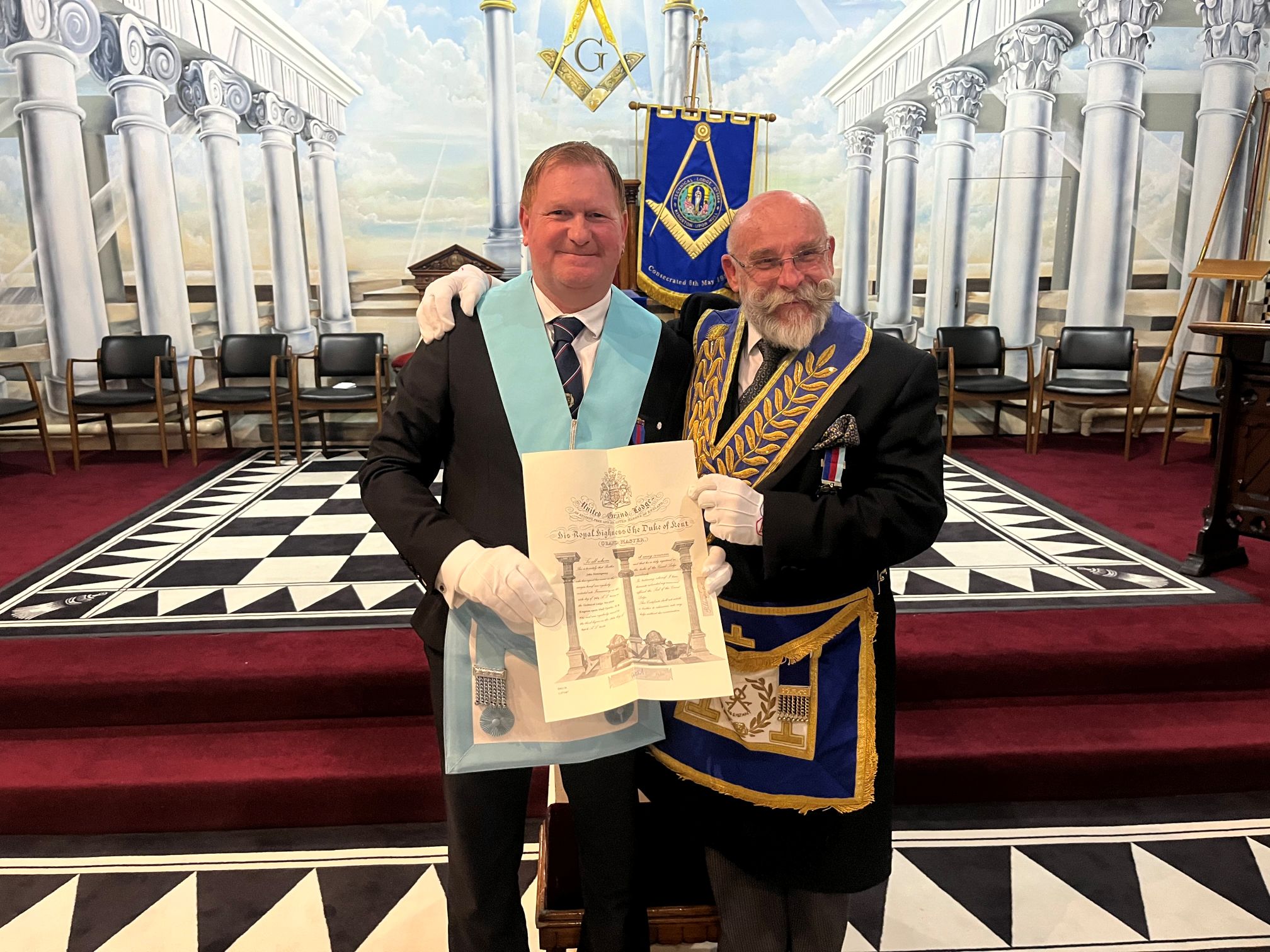
Bro John Hemingway and W Bro Eddie Wildman
It was a lovely moment in the evening, made all the more memorable by the way W.Bro. Eddie spoke. His delivery brought both importance and good humour to the occasion, ensuring that Bro. Hemingway’s achievement was properly recognised and warmly celebrated by all present.
The Worshipful Master then had the pleasure of presenting W.Bro. Paul Harper with a certificate of payment for £500 towards the Festival. It was a proud moment for the Lodge, reflecting the continued generosity and commitment of the Brethren in supporting such an important cause. The presentation was warmly received and served as a fitting reminder of the charitable spirit that sits at the heart of Freemasonry.
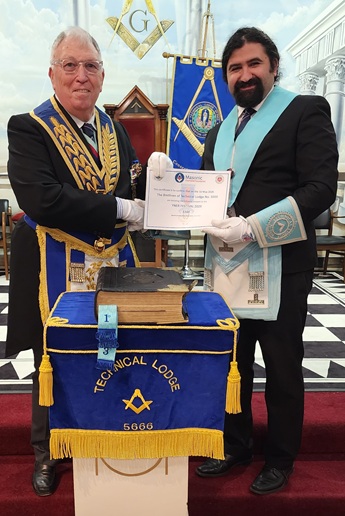
Representative of the RWPGM W Bro Paul Harper
and Technical WM W Bro Arash Vesali (Photo from W Bro Wildman)
In true Masonic tradition, the evening continued with a lively and well-attended Festive Board. The dining room was filled with conversation, laughter, and the easy companionship that follows a ceremony well performed.
It was a fitting end to a memorable evening, with Brethren enjoying good food, good company, and the warmth of shared fellowship. The night concluded in the traditional manner with the parting song, “Happy to Meet Again”, echoing through the hall in a spirit of joy and unity, and reminding everyone present that there will be many more good evenings to come.
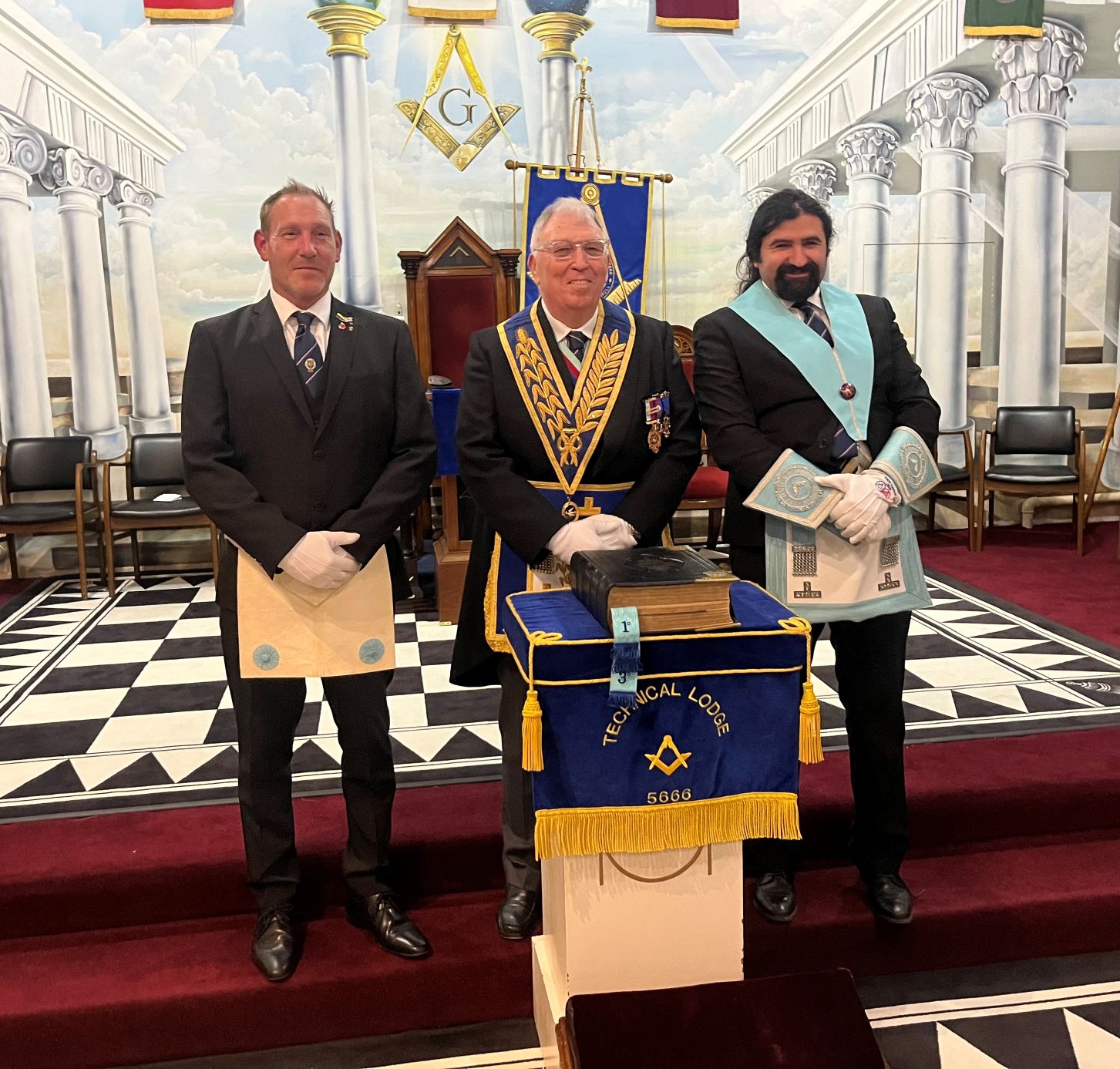
Bro Michael Carr, W Bro Paul Harper, W Bro Arash Vesali
By Ed Thompson, Senior Deacon, Principal Sojourner 12th May 2026
Tuesday 12th May was the Humber Lodge No.57 Founders Night and the latest of Technical Lodge No.5666's excursions.
When I picked up W Bro Ian Parkinson, it occured to me that I had a Masonic founder sat next to me as we drove towards a blustery Hull Marina. 'Parki' was a founding member of Phoenix Lodge No.9963 in 2018 and served as Worshipful Master from 2020-2022. Phoenix Lodge has had its struggles but - symbolically rising like its namesake - it is now thriving and under the astute Mastership of Technical Lodge's very own W Bro Paul Hillary. Humber Lodge is much older than Phoenix Lodge. Although it was officially designated No.57 in 1863, Humber can trace its original warrant back to May 19th 1756, making the Lodge effectively 270 years old.
Technical Lodge were busy visiting again and we managed to bring along decent numbers. W Bro Parkinson and I were warmly received at the Masonic Hall at Dagger Lane - as is the gentle, warm culture of Humber Lodge.
Soon enough, shrieking groans of pain could be heard as 'Parki' made his way through the Brethren already stationed in the bar area. His signature 'crusher' handshake has largely been contained to the South of the Province. But, as 'Parki' will be soon invested as a Provincial Chapter Steward in August, his brawn will no doubt be spread to the Cental and Northern regions of Province. They have not been warned.
At the bar, we rendezoused with more Technical brethren namely W Bro Anthony James, Bro John Hemingway - recently made a Master Mason - and our very own Worshipful Master W Bro Arash 'Ash' Vesali - it was his birthday!
With five members, we looked in good stead to complete a difficult Provincial-wide challenge - claiming the Travelling Gavel. This is wonderful incentive, created by Humber Lodge, to encourage visiting around the Province of Yorkshire North & East Ridings. Given the considerable geographical acreage of YNER, from Hull and Howden to Middlesbrough and Redcar, the Gavel cannot be easily hunted and successfully obtained. The Gavel had only returned home at Humber Lodge for six days. They had wrestled it from Kingston Lodge, outnumbering visiting rivals from Holderness Lodge on 6th May. The last time Technical Lodge claimed the gavel was December 2021.
The Royal Arch Chapter has it's own visiting incentive in our Province - The Travelling Sceptres. There are three; Northern, Central and Southern. Watch this space.
Founders Night celebrations were incoming but first Humber Lodge had important labour - a Ceremony of Passing Bro Julian Edge to the Degree of a Fellow Craft. Humber Lodge has very impressive ritualists and overall the ceremony was very heartfelt and wholesome. Technical Master W Bro Vesali gave greetings on behalf of Technical before demanding submission of the Gavel. We then headed downstairs from labour to refreshment.
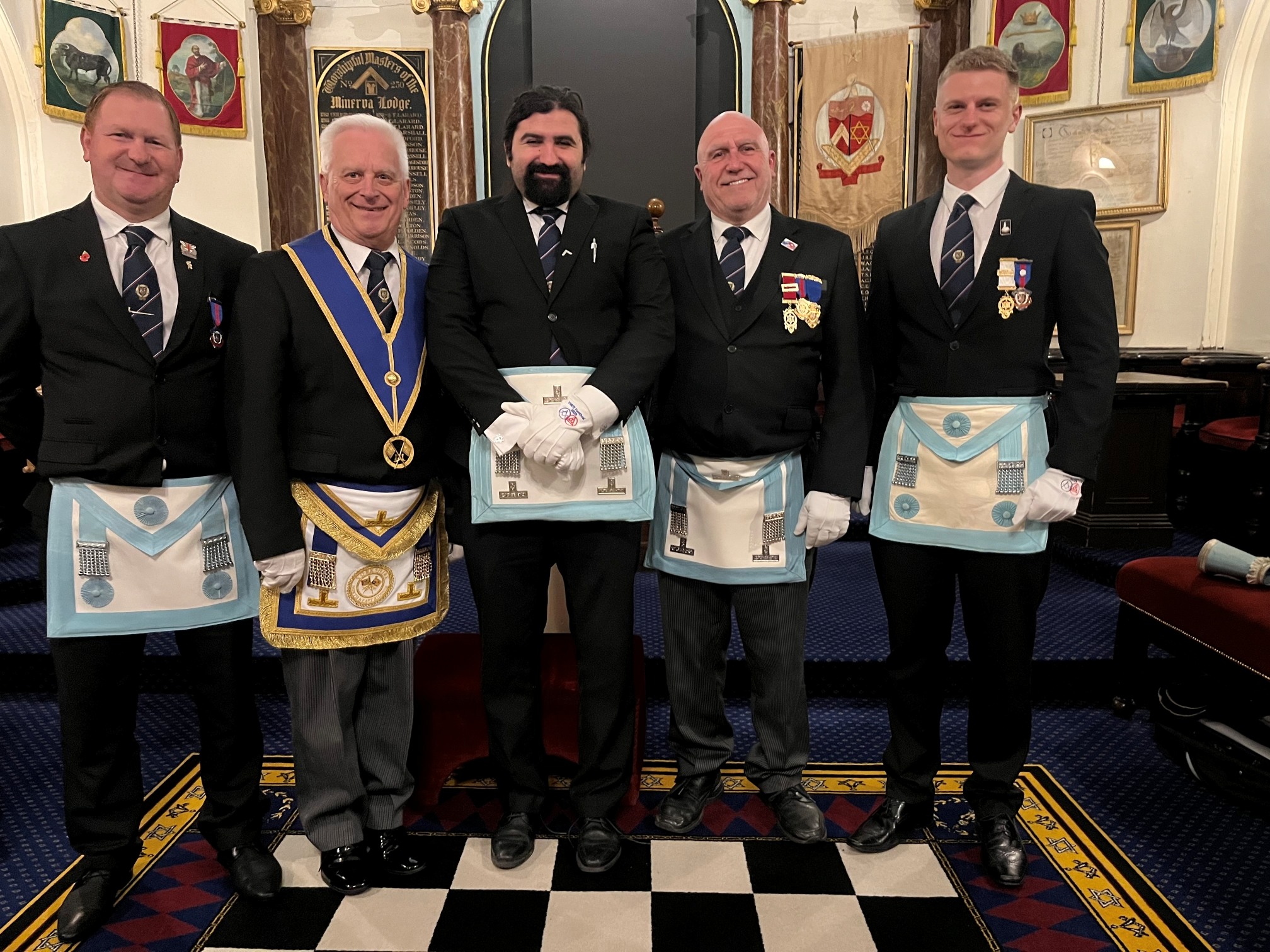
L to R: Bro John Hemingway, W Bro Anthony James, WM W Bro Arash Vesali, W Bro Ian Parkinson, Bro Ed Thompson
At the Senior Warden's end of the festive board, we were joined by many others vistors. Most interesting amongst them were brethren from Pelham Pillar Lodge from Lincolnshire, who trace their history directly from Humber Lodge. We enjoyed great company.
After some great food and conversation, W Bro Eddie Wildman delivered a fascinating Founders Night presentation to the Brethren - this was highly illuminating and enjoyable.
'Ash' - the birthday boy - was left smiling after he won some wine in the raffle. He was even more so taken aback when it was announced by WM Malcom Forbes that we would all serenade his special day, assisted by the brilliant musical accompaniment of W Bro Eddie. 'Happy Birthday' thundered. There was also a formal presentation of The Travelling Gavel to W Bro Vesali and all visiting Technical brethren.
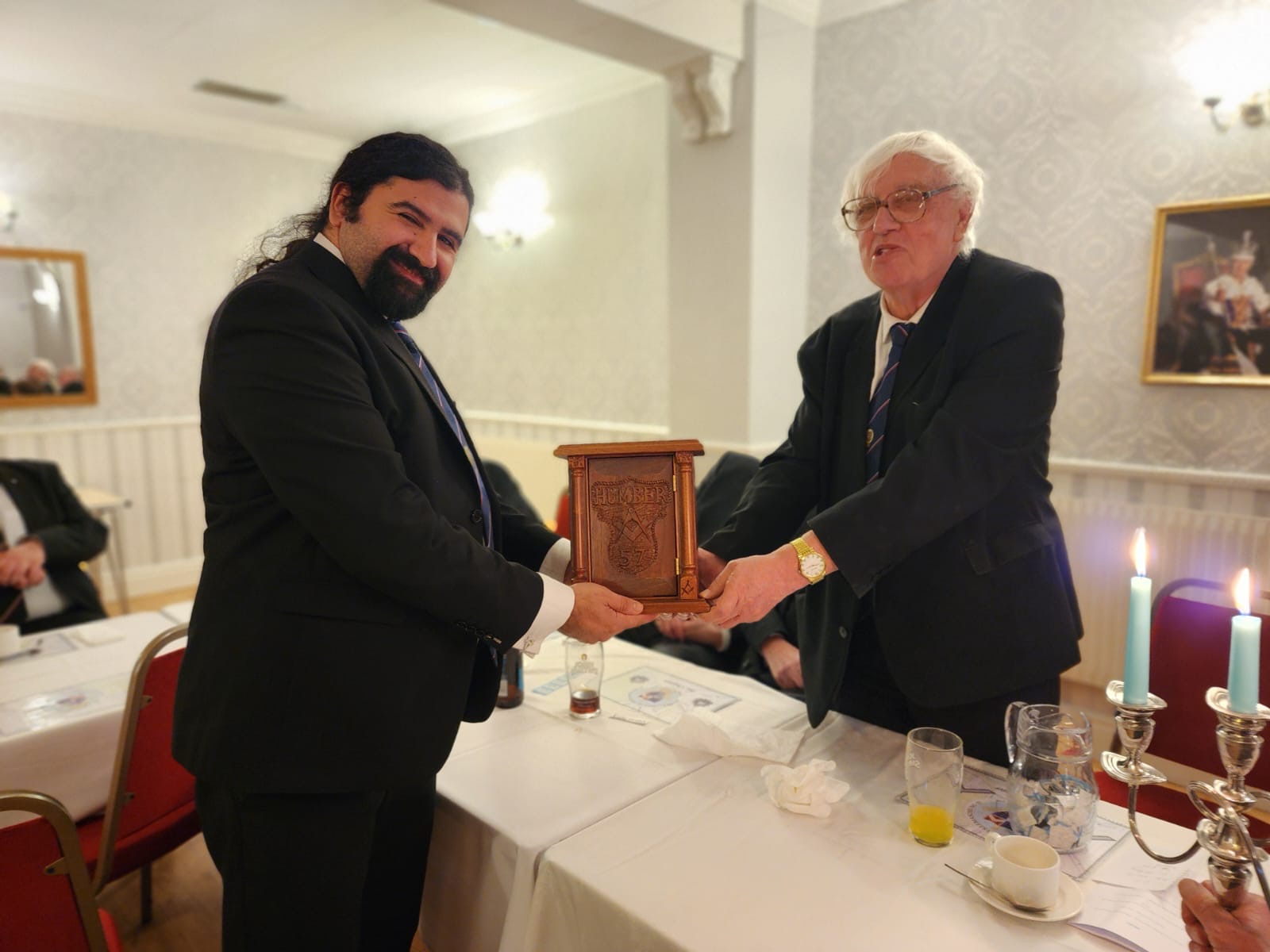
Technical WM Arash Vesali receiving the Travelling Gavel from Humber WM W Bro Malcom Forbes
The 'Visitor's Song' was powerfully sang - led by W Bro Richard Smedley - whilst all Humber Brethren shook hands with us. I've visited Humber Lodge & Chapter a few times now, yet the level of Brotherly Love you experience as a visitor never fades away.
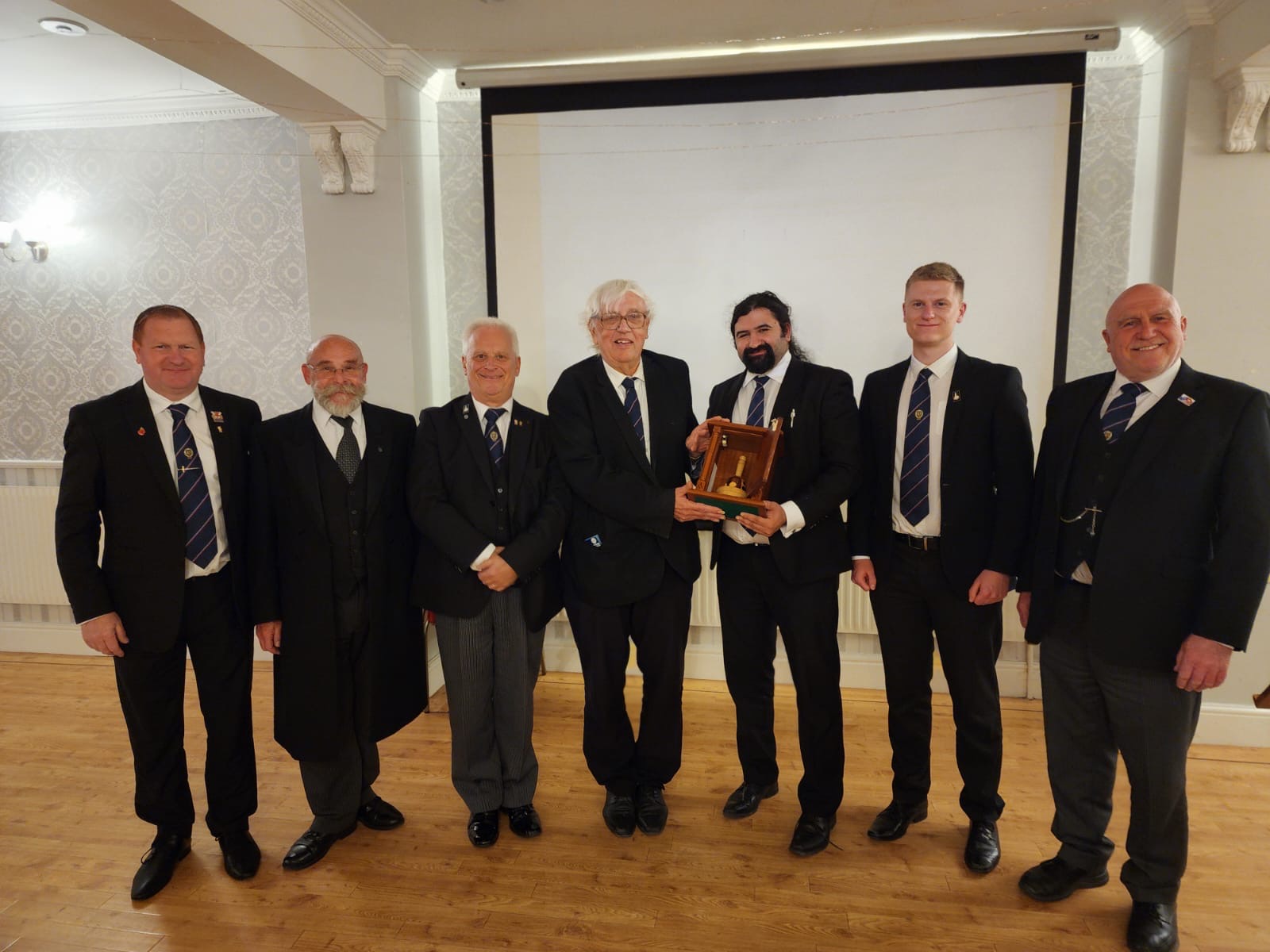
L to R: Bro John Hemingway, W Bro Eddie Wildman, W Bro Anthony James, W Bro Malcolm Forbes, W Bro Arash Vesali, Bro Ed Thompson, W Bro Ian Parkinson
When festivities concluded, we said our heartfelt goodbyes and made our way out before 10 o' clock. Myself and Ash stepped out onto the beautiful aesthetic of Prince Street. The torturous earlier wind had settled and a sense of calm was in the air...
Suddenly and sharply, calmness evaporated into shock and despair.
Parki, whilst bullishly leaving the building directly after us, yanked the door back too hard and a concerning 'CRACK!!!' emanated and echoed all around us.
Had Parki destroyed the Dagger Lane door... on Founders Night?
I immediately stepped back in and we observed the aftermath. The overhead door closing mechanism did not look good. We fiddled with it. We reconnected a part that fell off. Eventually, the three of us were fairly confident that it was mended.
Whilst the door was visibly repaired, the state of the Metacarpal bones in the hands of the Humber Brethren is unknown. Thankfully, the Travelling Gavel went home with Ash - all in one piece...
By Ed Thompson, Senior Deacon, Principal Sojourner 9th May 2026
When I picked up W Bro Paul Hillary (the to-be Provincial Grand Treasurer of the Province of Yorkshire North & East Ridings) the day was early and bright. I may have arrived outside of Paul's house at about five past eight in the morning. This was only five minutes after I picked up W Bro Steve Berry who was in good sprits and made for good company in the front of the car. Their close proximity of repsective dwellings made the journey to our desired destination very easy and efficiently done. Our destination, of course, was the Investiture of our new Provincial Grandmaster & Grand Superintendent Mark Iveson (and some of his key team members too) of the Province of Yorkshire North & East Ridings.
The weather was fair on the way to York and W Bro Berry, W Bro Hillary and I arrived at York Racecourse for just gone 9 o' clock. Walking towards the entrance, Paul and I discussed our love (or perhaps chemical reliance) of coffee. A few moments later we had taken the lift up to the top of the Knavesmire Stand, took off to the bar and refreshed ourselves with a cup of the aforementioned beverage and pottered around before this monumental event was due to start.
After getting suited, booted and jeweled up, we made our way downstairs to the first grand occasion - the Investiture of W Bro Mark Iveson as Grand Superintendent (this first occasion was in the Royal Arch Chapter). I will not dilate on much of any ceremony however it was particularly incredible to see something in both the Chapter and Craft Investitures - the active UGLE officers and their level of ritualistic profeciency, most notably the DCs and the Assistant Grandmaster & Past 3rd Grand Principal RW Steven Varley who initally took control of proceedings and later to invest W Bro Iveson.
I mentioned earlier that some of W Bro Iveson's key members were invested too, none more significant to the unit of Technical 5666 than W Bro Dr. Hiten Thaker. He was invested by the new Grand Superintendent as Deputy Grand Superintendent. Myself, W Bros Paul and Steve and other Technical Chapter companions in attendance were proud to be there to see him invested with this high honour in the flesh. For a moment I wanted to shout and cheer but I quickly reminded myself of the formality of this occasion. Hull City were playing in the Championship Play Offs the night before and I perhaps had some latent adrenaline in my system. I held my tongue.
After this ceremony concluded, it was time for lunch. The travelling Technical crew were temporarily seperated. Whilst myself and W Bro Steve were seated with some fine and distinguished brethren from Humber Lodge 57 - assumingly due to us all belonging to lodges South in Province. W Bro Paul however was placed on a different table in the seating plan. "You must've been on one of the important tables", I later remarked. "I don't know why I was but I'm definitely not important. I'm just happy because somebody had wine pre-ordered on ours", Paul replied. I was slightly envious of that but I remembered I was driving and gratefully drank my ol' reliable Guinness 0.0.
The food was very tasty, the company was joyful and before we knew it we all were downstairs again, ready for the next and final occasion - W Bro Iveson's investiture as Provincial Grandmaster.
The ceremony was simlilar in many ways to the Royal Arch Chaper one that preceded it. Now in the Craft, the newly invested PGM RW Bro Mark Iveson invested his Assistant Provincial Grandmasters, Wardens and other key officers in the Provincial Grand Lodge. This ceremony in the Craft was slightly more comprehensive. The Chapter one was intruiging but mainly focused on the investiture of the Three Prinicipals.
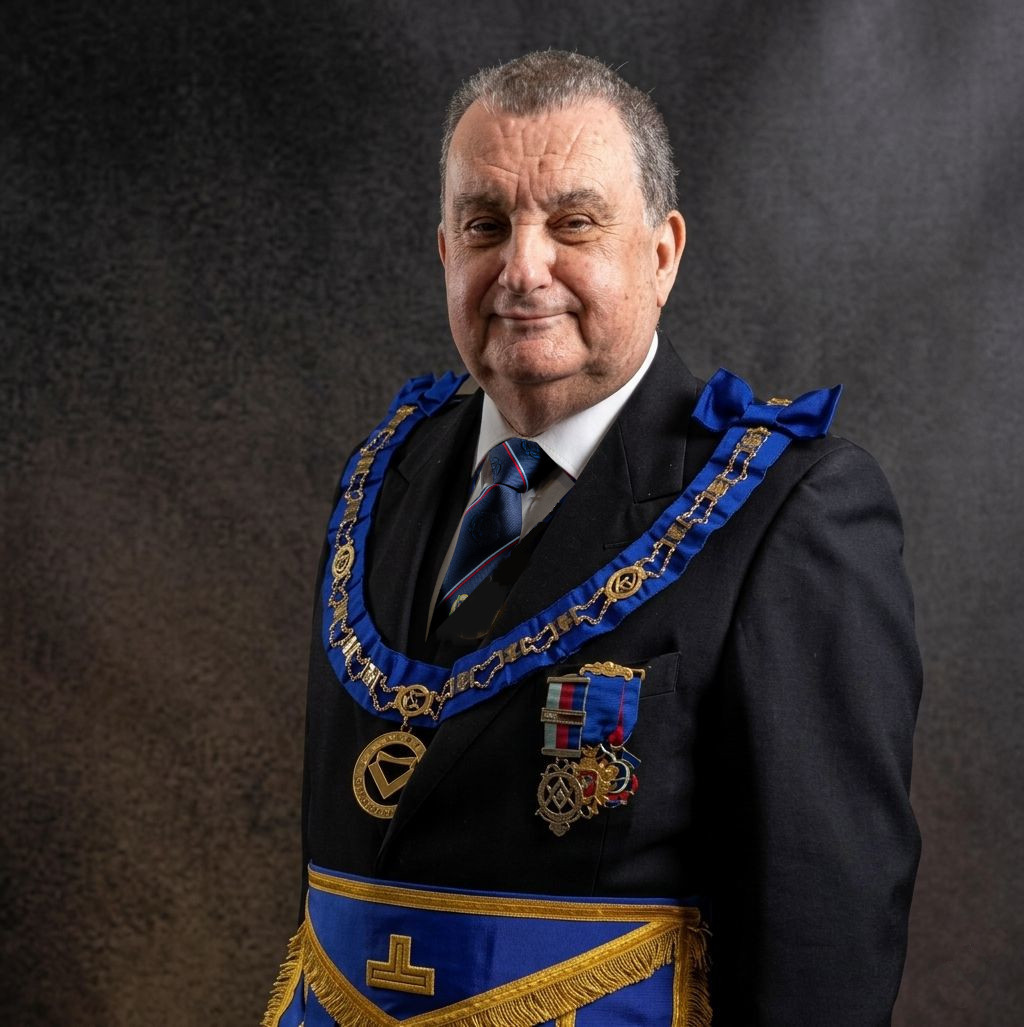
RW Bro Mark Iveson
Newly installed Provincial Grandmaster
& Grand Superintendent of Yorkshire North & East Ridings
Overall, all formal business in both ceremonies were filled with grandeur and unbelievably precise ritual - professionalism reigned.
When all was done, we headed back to my car with a slight hint of drizzle. Driving home, W Bro Paul was particularly jolly (thank you to whomever ordered that wine) and we three had enjoyable conversation for the full hour of journey. Unfortunately as I dropped them off, it was now heavily precipating but the warmth and comfort of a home was incoming. This was only a fleeting escape for Paul, however, as he had dog walk duties to fulfil. My late great-grandmother was Danish and I quite like the Scandanavian attitude of 'There is no bad weather, only bad choice of clothing' but I nervously hesitated in reciting that to him as I dropped him off.
We had a great time together. It is always fun to get out and visit, whether that is a Lodge, a Chapter, an Installation, a White Table Event or indeed a large Provincial event as we did today. It was made extra special for Technical 5666 too, by way of W Bro Hiten's investiture as DGS (Deputy Grand Superintendent).
Luckily, it doesn't stop here for Technical Lodge. On 1st August, many more Brethren and Companions are receiving honours and promotions in Freemasonry at the next Provincial Event - we will be supporting them in numbers, with smiles on our faces.